
www.industryemea.com
20
'26
Written on Modified on
Geospatial AI Layer Enables Deterministic Location Decisions
HERE Technologies launches Location Reasoning to improve spatial computation for AI systems operating in logistics, mobility and enterprise environments.
www.here.com
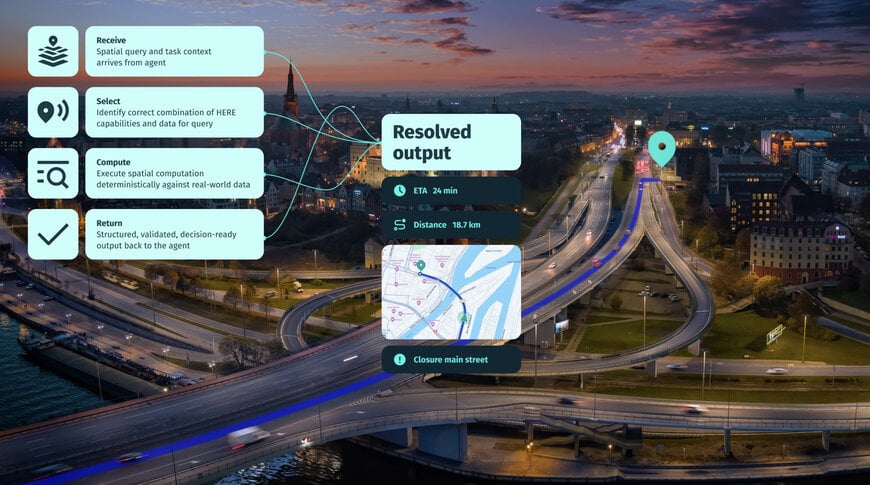
HERE Technologies has introduced HERE Location Reasoning, a geospatial grounding system designed to improve how AI models and agentic systems interpret and act on real-world location data. The platform combines enterprise mapping, live traffic information and road intelligence to support deterministic location reasoning for applications including mobility, logistics, fleet operations and autonomous decision-making.
Location reasoning addresses limitations in AI spatial computation
As AI systems increasingly transition from generating responses to executing real-world actions, location-aware decision-making has become a critical requirement. Conventional large language models (LLMs) are not designed to consistently resolve spatial problems involving traffic conditions, routing constraints or dynamic infrastructure changes.
HERE Location Reasoning aims to address this limitation by externalising spatial computation from the language model and executing location-based queries through structured workflows using mapping and real-time environmental data.
According to HERE, the system converts spatial requests into deterministic execution processes rather than relying on probabilistic model outputs, reducing inconsistencies in tasks involving navigation, routing and operational planning.
Geospatial grounding supports logistics and mobility applications
The technology targets scenarios requiring accurate real-time decisions based on location constraints. Example applications include:
- Identifying EV charging stations accessible within specific route constraints
- Calculating routes considering vehicle restrictions and traffic conditions
- Determining service availability based on travel time and operating hours
- Optimising technician dispatch in field service operations
- Supporting fleet routing under dynamic traffic and scheduling conditions
These workflows require combining static map attributes with continuously changing environmental inputs such as congestion patterns and road restrictions.
Deterministic execution aims to improve speed and cost efficiency
The company states that HERE Location Reasoning is engineered to improve operational efficiency by reducing latency and limiting unnecessary downstream API requests or excessive token consumption.
The platform’s stated characteristics include:
Deterministic execution aims to improve speed and cost efficiency
The company states that HERE Location Reasoning is engineered to improve operational efficiency by reducing latency and limiting unnecessary downstream API requests or excessive token consumption.
The platform’s stated characteristics include:
- Deterministic outputs producing identical results under identical inputs and constraints
- Lower computational overhead for location-intensive AI workflows
- Integration of dynamic traffic and road network conditions
- Privacy-focused architecture that avoids retaining user identity or query history
Reducing token usage and external API calls may become increasingly relevant as enterprises seek to control costs associated with deploying AI systems at scale.
Enterprise map infrastructure underpins geospatial AI capabilities
The system builds on HERE’s mapping platform, which the company states includes more than 68 million kilometres of mapped roads across over 200 countries and territories.
The platform incorporates road geometry, connectivity, traffic behaviour and regulatory information, updated using large volumes of real-world signals. According to HERE, more than 238 million vehicles currently use its location technologies.
This underlying infrastructure is intended to provide AI systems with continuously updated representations of physical environments rather than relying on static datasets.
Geospatial execution layers emerge as infrastructure for agentic AI
The introduction of HERE Location Reasoning reflects a broader trend toward specialised execution layers designed to support agentic AI systems operating in physical environments. Rather than embedding all reasoning within foundation models, these architectures delegate domain-specific computations to external systems optimised for particular tasks.
For mobility, logistics and autonomous operations, geospatial reasoning systems may become increasingly important as AI agents move from information retrieval toward real-world decision execution.
HERE Location Reasoning is currently available through selected customer and partner engagements.
Additional Context
Technical specifications and competitive context not included in the original announcement
Enterprise geospatial platforms are commonly evaluated based on map coverage, update frequency, routing capabilities, traffic intelligence and integration with AI workflows. HERE reports coverage of more than 68 million kilometres of roads across over 200 countries and territories, supporting more than 238 million connected vehicles.
Other major providers in enterprise location services, including Google Maps Platform and Mapbox, offer APIs for routing, geocoding and traffic analysis. However, HERE positions Location Reasoning differently by introducing a deterministic execution layer intended to perform structured spatial computation for AI systems rather than supplying location data alone.
The emergence of dedicated geospatial reasoning layers reflects broader industry efforts to improve how AI systems process real-world constraints such as traffic, road rules and vehicle limitations in logistics and mobility applications.
Edited by Natania Lyngdoh, Induportals editor, assisted by AI.
www.here.com
Enterprise map infrastructure underpins geospatial AI capabilities
The system builds on HERE’s mapping platform, which the company states includes more than 68 million kilometres of mapped roads across over 200 countries and territories.
The platform incorporates road geometry, connectivity, traffic behaviour and regulatory information, updated using large volumes of real-world signals. According to HERE, more than 238 million vehicles currently use its location technologies.
This underlying infrastructure is intended to provide AI systems with continuously updated representations of physical environments rather than relying on static datasets.
Geospatial execution layers emerge as infrastructure for agentic AI
The introduction of HERE Location Reasoning reflects a broader trend toward specialised execution layers designed to support agentic AI systems operating in physical environments. Rather than embedding all reasoning within foundation models, these architectures delegate domain-specific computations to external systems optimised for particular tasks.
For mobility, logistics and autonomous operations, geospatial reasoning systems may become increasingly important as AI agents move from information retrieval toward real-world decision execution.
HERE Location Reasoning is currently available through selected customer and partner engagements.
Additional Context
Technical specifications and competitive context not included in the original announcement
Enterprise geospatial platforms are commonly evaluated based on map coverage, update frequency, routing capabilities, traffic intelligence and integration with AI workflows. HERE reports coverage of more than 68 million kilometres of roads across over 200 countries and territories, supporting more than 238 million connected vehicles.
Other major providers in enterprise location services, including Google Maps Platform and Mapbox, offer APIs for routing, geocoding and traffic analysis. However, HERE positions Location Reasoning differently by introducing a deterministic execution layer intended to perform structured spatial computation for AI systems rather than supplying location data alone.
The emergence of dedicated geospatial reasoning layers reflects broader industry efforts to improve how AI systems process real-world constraints such as traffic, road rules and vehicle limitations in logistics and mobility applications.
Edited by Natania Lyngdoh, Induportals editor, assisted by AI.
www.here.com
