
www.industryemea.com
06
'26
Written on Modified on
Digital Air Gap Measurement for Hydroelectric Generators
Kaman develops an electronic static clearance evaluation device designed to automate diagnostic data collection and streamline heavy industrial condition monitoring.
www.kamansensors.com
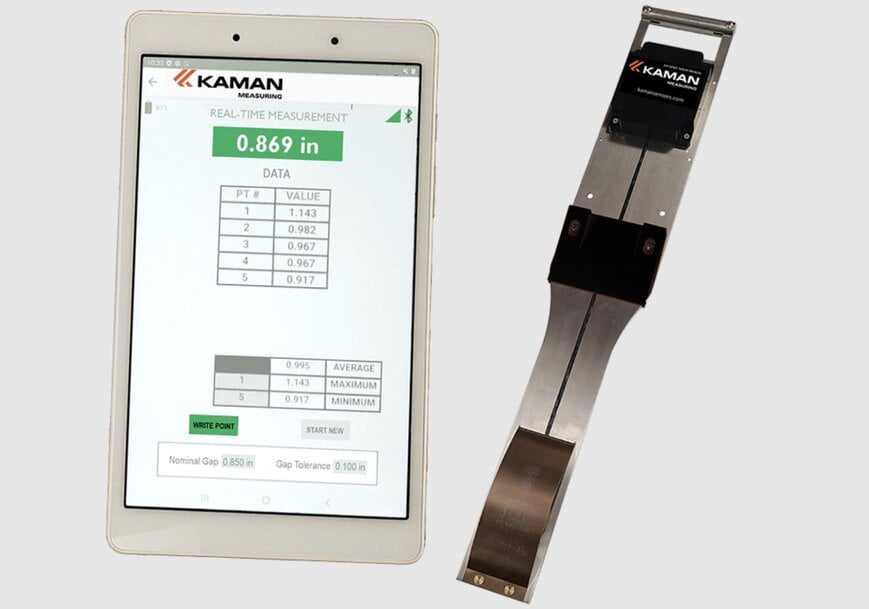
Source: Kaman Measuring
Kaman is releasing the Static Air Gap Tool (AGT), a portable electronic measurement device that calculates the physical clearance between the rotor and stator within large-scale hydroelectric generators. This hardware replaces traditional mechanical measurement methods, providing a digital diagnostic solution for structural alignment during initial installation and post-maintenance reassembly.
Mechanical Clearances and Hydroelectric Rotor Alignment
An air gap is the critical distance between the rotor and stator of a hydroelectric generator. While this gap represents a minute fraction of the overall rotor size, maintaining exact tolerances is required to prevent mechanical friction and preserve power generation efficiency. Static measurement of this clearance is mandatory prior to rotation, specifically during construction, periodic maintenance, and extensive overhaul operations. Traditional static measurements rely on mechanical tools known as "parallels," which demand extensive manual labor and subjective physical alignment by technicians.
Eddy Current Sensing and Hardware Mechanics
The AGT automates this diagnostic process by sliding a measurement paddle equipped with compression springs into the gap between the stator and rotor. An eddy current sensor coil situated between these springs captures the physical compression in real time. Because the springs are wide enough to accommodate various rotor and stator winding geometries, the device functions across different generator architectures without manual physical adjustments.
Signal conditioning electronics located at the handle translate the inductance changes from the sensor coil into exact distance metrics, displaying data in either imperial or metric units. Operating horizontally or vertically depending on generator design, the device is factory calibrated to National Institute of Standards and Technology (NIST) traceable standards, achieving a measurement accuracy of 0.001 inches across a range of 0.4 to 1.3 inches. Adjustable wedges allow for a consistent insertion depth, and the system runs on a rechargeable battery that sustains up to eight hours of continuous operation.
Wireless Transmission and the Industrial Data Ecosystem
To integrate these physical measurements into an industrial data ecosystem, the paddle wirelessly transmits telemetry via Bluetooth to a mobile application on iOS or Android devices operating within a 10- to 15-foot range. The application sequences and stores data points automatically, utilizing voice commands or physical touch inputs to log each measurement. In environments exhibiting high electromagnetic interference, or where wireless signals are restricted, the paddle connects to the mobile device via a standard USB cable. This digital data collection eliminates manual entry errors and allows engineers to export the diagnostic files directly to a PC for analysis, establishing a reliable condition monitoring ecosystem for predictive maintenance operations.
Field Deployment and Operational Cycle Time Reduction
Applying electronic measurement to physical clearances yields a quantifiable reduction in overhaul technician hours. In a recent field test at a U.S. hydro-generating facility, operators utilized the AGT to measure clearances across all generator poles. Mechanical parallels previously required two hours to measure just every third pole. The electronic paddle completed measurements for all poles in 30 minutes.
When accounting for required measurements both above and below the rotor, the electronic system saved three hours of continuous labor. The subsequent data, downloaded into a spreadsheet software to generate structural radar plots, demonstrated high repeatability when tested by alternating operators, ultimately facilitating up to a 90% reduction in overall inspection time requirements.
Additional Context
This section details technical specifications and competitive benchmarking not included in the original news release.
Within the hydroelectric generator maintenance sector, static air gap measurements are traditionally performed using mechanical feeler gauges or step wedges. As the industry digitizes, electronic alternatives typically fall into two categories: capacitive sensor wands and eddy current tools. Competitors utilizing capacitive technology, such as the static gap wedges from Iris Power, measure the dielectric capacitance of the space between sensor plates. While highly accurate in controlled conditions, capacitive sensors can experience measurement drift if oil, dust, or moisture alters the dielectric constant of the air inside the gap. The Kaman AGT utilizes an eddy current measurement mechanism, which relies on magnetic field variation rather than electrical capacitance, rendering it immune to non-conductive contaminants like machine oil. Furthermore, traditional mechanical gauges provide a fixed step-resolution, whereas the integrated signal conditioning of this electronic tool delivers an absolute measurement accuracy of 0.001 inches, establishing strict baseline data for precision rotor alignment.
Edited by Aishwarya Mambet, Induportals Editor, with AI assistance.
www.kaman.com
Kaman is releasing the Static Air Gap Tool (AGT), a portable electronic measurement device that calculates the physical clearance between the rotor and stator within large-scale hydroelectric generators. This hardware replaces traditional mechanical measurement methods, providing a digital diagnostic solution for structural alignment during initial installation and post-maintenance reassembly.
Mechanical Clearances and Hydroelectric Rotor Alignment
An air gap is the critical distance between the rotor and stator of a hydroelectric generator. While this gap represents a minute fraction of the overall rotor size, maintaining exact tolerances is required to prevent mechanical friction and preserve power generation efficiency. Static measurement of this clearance is mandatory prior to rotation, specifically during construction, periodic maintenance, and extensive overhaul operations. Traditional static measurements rely on mechanical tools known as "parallels," which demand extensive manual labor and subjective physical alignment by technicians.
Eddy Current Sensing and Hardware Mechanics
The AGT automates this diagnostic process by sliding a measurement paddle equipped with compression springs into the gap between the stator and rotor. An eddy current sensor coil situated between these springs captures the physical compression in real time. Because the springs are wide enough to accommodate various rotor and stator winding geometries, the device functions across different generator architectures without manual physical adjustments.
Signal conditioning electronics located at the handle translate the inductance changes from the sensor coil into exact distance metrics, displaying data in either imperial or metric units. Operating horizontally or vertically depending on generator design, the device is factory calibrated to National Institute of Standards and Technology (NIST) traceable standards, achieving a measurement accuracy of 0.001 inches across a range of 0.4 to 1.3 inches. Adjustable wedges allow for a consistent insertion depth, and the system runs on a rechargeable battery that sustains up to eight hours of continuous operation.
Wireless Transmission and the Industrial Data Ecosystem
To integrate these physical measurements into an industrial data ecosystem, the paddle wirelessly transmits telemetry via Bluetooth to a mobile application on iOS or Android devices operating within a 10- to 15-foot range. The application sequences and stores data points automatically, utilizing voice commands or physical touch inputs to log each measurement. In environments exhibiting high electromagnetic interference, or where wireless signals are restricted, the paddle connects to the mobile device via a standard USB cable. This digital data collection eliminates manual entry errors and allows engineers to export the diagnostic files directly to a PC for analysis, establishing a reliable condition monitoring ecosystem for predictive maintenance operations.
Field Deployment and Operational Cycle Time Reduction
Applying electronic measurement to physical clearances yields a quantifiable reduction in overhaul technician hours. In a recent field test at a U.S. hydro-generating facility, operators utilized the AGT to measure clearances across all generator poles. Mechanical parallels previously required two hours to measure just every third pole. The electronic paddle completed measurements for all poles in 30 minutes.
When accounting for required measurements both above and below the rotor, the electronic system saved three hours of continuous labor. The subsequent data, downloaded into a spreadsheet software to generate structural radar plots, demonstrated high repeatability when tested by alternating operators, ultimately facilitating up to a 90% reduction in overall inspection time requirements.
Additional Context
This section details technical specifications and competitive benchmarking not included in the original news release.
Within the hydroelectric generator maintenance sector, static air gap measurements are traditionally performed using mechanical feeler gauges or step wedges. As the industry digitizes, electronic alternatives typically fall into two categories: capacitive sensor wands and eddy current tools. Competitors utilizing capacitive technology, such as the static gap wedges from Iris Power, measure the dielectric capacitance of the space between sensor plates. While highly accurate in controlled conditions, capacitive sensors can experience measurement drift if oil, dust, or moisture alters the dielectric constant of the air inside the gap. The Kaman AGT utilizes an eddy current measurement mechanism, which relies on magnetic field variation rather than electrical capacitance, rendering it immune to non-conductive contaminants like machine oil. Furthermore, traditional mechanical gauges provide a fixed step-resolution, whereas the integrated signal conditioning of this electronic tool delivers an absolute measurement accuracy of 0.001 inches, establishing strict baseline data for precision rotor alignment.
Edited by Aishwarya Mambet, Induportals Editor, with AI assistance.
www.kaman.com
