
www.industryemea.com
23
'26
Written on Modified on
SGE, GE Vernova, Hitachi and Samsung C&T Advance European BWRX-300 Deployment
MoU establishes cooperation on market development and commercial opportunities for small modular reactor fleets across Central, Eastern Europe and the United Kingdom.
www.gevernova.com
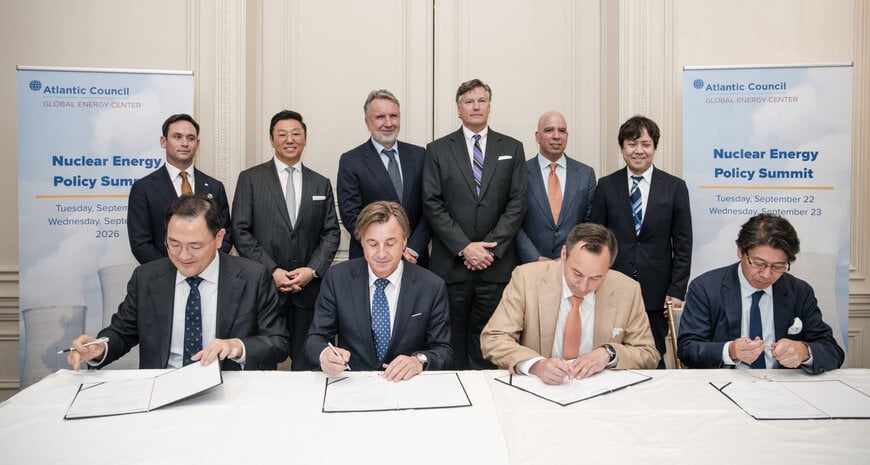
SGE, GE Vernova, Hitachi, and Samsung C&T signed a Memorandum of Understanding to coordinate the deployment and market development of the BWRX-300 small modular reactor across Central and Eastern Europe and the United Kingdom. This joint effort provides low-carbon baseload generation to support regional energy security and industrial digital infrastructure.
Operational Challenges and Strategic Alignment
Deploying utility-scale nuclear installations requires cross-border licensing, robust component supply chains, and established engineering, procurement, and construction (EPC) execution. SMR fleet rollouts depend on standardizing unit delivery to lower civil engineering lead times and project capital expenditure compared to traditional gigawatt-scale plants. The four-party partnership resolves these constraints by integrating regional site development, reactor design, supplier qualification, and EPC project delivery into a unified deployment framework.
Division of Technical Responsibilities
Technical authority and architecture are divided along specific engineering domains:
GE Vernova Hitachi Nuclear Energy (GVH) serves as the primary technology designer for the BWRX-300, providing engineering specifications, standard system designs, and core nuclear physics documentation.
Hitachi provides industrial engineering and integrates certified Japanese component supply chains, applying digital process control systems to plant monitoring.
Samsung C&T handles EPC execution, bringing international experience in major infrastructure management, standardized modular construction, and site-level integration.
SGE manages regional site permitting, utility engagement, regulatory compliance, and overall project ownership as the exclusive developer across target territories in Central and Eastern Europe.
Technical Solution and Design Parameters
The BWRX-300 is a 300 MW water-cooled, natural-circulation small modular reactor based on simplified boiling water reactor technology. The standardized design eliminates active safety injection pumps by using passive safety systems, which use gravity-driven natural circulation and isolation condenser loops to manage post-shutdown heat removal without alternating-current electrical power. This modular architecture allows off-site component fabrication, reducing concrete volume and civil construction timelines compared to traditional plants.
Deployment Pipeline and Grid Integration
Initial European implementation focuses on multi-unit sites:
In Poland, official Decisions in Principle have been granted for 26 units, with immediate engineering priorities focusing on three sites configured for the initial 14 reactors.
In the United Kingdom, SGE is developing a 4.2 GW fleet comprising 14 units across three multi-unit sites, which has entered the Preliminary Regulatory Assessment phase with domestic nuclear bodies.
Additional site feasibility evaluations are underway across Central and Eastern Europe to integrate these units into regional high-voltage transmission systems, providing industrial baseload power and thermal energy for process manufacturing.
Expected Operational Impact
Standardized fleet replication mitigates licensing variance across jurisdictions, establishes multi-unit operational synergies, and delivers continuous 300 MW blocks of low-carbon electricity to stabilize European transmission networks during periods of variable renewable generation.
Edited by Natania Lyngdoh, Induportals editor, assisted by AI.
www.gevernova.com
