
www.industryemea.com
27
'26
Written on Modified on
Precision Control Architecture for Water Electrolysis Decarbonization
Industrial hydrogen systems incorporate motor-driven valves and inline sensors from Bürkert to optimize process stability and energy consumption.
www.burkert.com
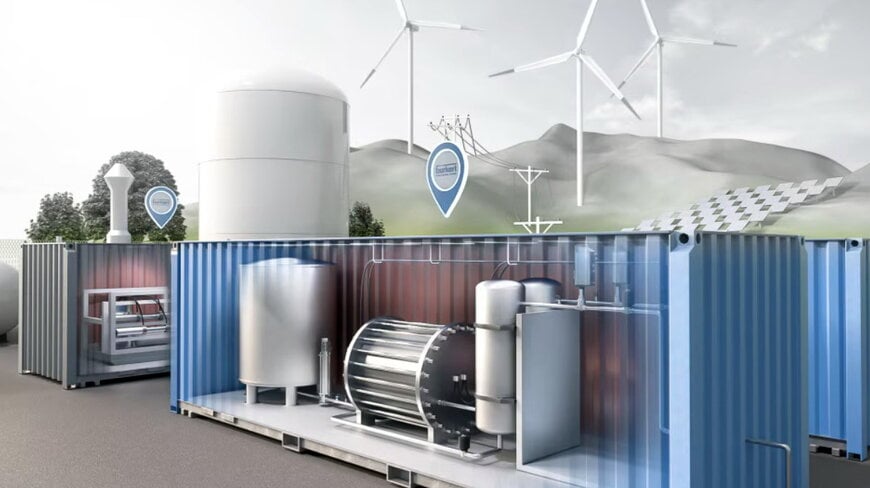
Water electrolysis systems require continuous flow control, precise pressure balancing, and rapid gas isolation to maximize energy efficiency and operational safety across multi-gigawatt hydrogen production facilities.
The core process flow begins at the water supply stage, where fresh or cooling water is routed through motorized proportional control valves and inline paddle wheel flowmeters alongside analytical sensors for conductivity and temperature. This prepared stream enters the electrolyser stack, which can utilize alkaline, proton exchange membrane, or solid oxide electrolysis technologies. Within the stack, the process branches into two distinct operational sides: the anode side generating oxygen and the cathode side generating hydrogen. Each outlet is monitored by a stainless steel flush diaphragm pressure transmitter and managed by dedicated electromotive back pressure control valves. Finally, both gas streams pass through fast-response solenoid valves to enable immediate safety cutoff prior to downstream gas processing.
Process Efficiency in Water Electrolysis
Hydrogen generation via alkaline electrolysis, proton exchange membrane electrolysis, and solid oxide electrolysis demands high electrical input to break molecular bonds in water. Fluctuations in fluid supply, system pressure, and stack temperature introduce efficiency losses, increased electrical consumption, and thermal stress on internal components.
To stabilize process dynamics, hydrogen system developers integrate industrial automation components to regulate water feed, balance half-cell pressures, and isolate hazardous gas streams during transient loads and operational shutdowns.
Component positioning across the system architecture focuses on targeted functions. At the water supply stage, the Bürkert Type 3280 valve maintains a zero-current position hold. For liquid feed lines, the Bürkert Type 8030 flowmeter provides continuous measurement with an error margin within plus or minus one percent. At the stack outlets, the Bürkert Type 3361 valve manages back pressure for both the anode and cathode sides, while a stainless steel pressure transmitter provides flush diaphragm pressure monitoring. Finally, within gas processing sections, the Bürkert Type 6240 solenoid valve enables electrical emergency shut-off.
Technical Solution and Responsibilities
Bürkert supplies motor-driven control valves, solenoid valves, and inline sensors specifically configured for water preparation, stack pressure control, and safety isolation.
- Fluid Feed and Thermal Management: Motorized Type 3280 proportional valves regulate deionised feed water and cooling circuits. Direct-acting electromotive drives maintain set positions without continuous electrical current. Flow rates are verified by Type 8030 paddle wheel flowmeters with a measurement accuracy of plus or minus one percent and repeatability within plus or minus 0.4 percent.
- Half-Cell Pressure Balancing: Type 3361 electromotive valves manage back pressure on both anode (oxygen discharge) and cathode (hydrogen discharge) outlets. Dynamic regulation of resistance downstream prevents pressure differentials across internal membranes, suppressing gas crossover. Stainless steel pressure transmitters featuring flush diaphragms monitor discharge pressures within a 0.1 percent deviation range.
- Safety Cutoff: Type 6240 direct-acting solenoid valves provide electrical shut-off across gas separation, purification, and compression interfaces. Actuation utilizes dual-stage power modulation to execute rapid switching at high power before lowering to a reduced holding current.
Operational Deployment and System Integration
The integrated control architecture scales across development-stage test units and commercial production plants.
System execution relies on a three-stage operational progression. In the fluid input stage, high-precision flow regulation reduces pumping energy losses. This transitions to the electrolyser stack stage, where balanced half-cell operation maintains optimal chemical reaction conditions. The sequence concludes at the gas isolation stage, where rapid-response solenoid isolation prevents gas mixing during emergency shut-down events.
Proportional motorized valves interface directly with plant digital infrastructure, eliminating pneumatic control lines and compressor power requirements. Standardized fluidic connections and corrosion-resistant materials ensure compatibility with ultrapure water, concentrated oxygen, and pressurized hydrogen gas streams.
Edited by Evgeny Churilov, Induportals Media - Adapted by AI.
www.burkert.co.uk
The integrated control architecture scales across development-stage test units and commercial production plants.
System execution relies on a three-stage operational progression. In the fluid input stage, high-precision flow regulation reduces pumping energy losses. This transitions to the electrolyser stack stage, where balanced half-cell operation maintains optimal chemical reaction conditions. The sequence concludes at the gas isolation stage, where rapid-response solenoid isolation prevents gas mixing during emergency shut-down events.
Proportional motorized valves interface directly with plant digital infrastructure, eliminating pneumatic control lines and compressor power requirements. Standardized fluidic connections and corrosion-resistant materials ensure compatibility with ultrapure water, concentrated oxygen, and pressurized hydrogen gas streams.
Edited by Evgeny Churilov, Induportals Media - Adapted by AI.
www.burkert.co.uk
